
Home
Database Update 7 April 2013
- Details
The database has been updated and has grown from 289,917 to 291,183 names.
First Name-Nickname Dictionary Project
- Details

In case some of you have not latched on to the CHamorro Roots ~ Hale' CHamoru FaceBook group, just yesterday (April 6, 2013 CHamorro ST) we launched the First Name-Nickname Dictionary Project. Here's the link (updated as necessary) to some of the information being collected: http://docs.com/RUE4
Some interesting notes that have occurred and I have commented on:
1. Some pieces of oral history are being revealed. This is great because there usually are stories behind a nickname; whether it be by someone's ta'dung accent or an incidental event. I don't know you tell us! The nickname may be unique and isolated within a particular family.
Some of the entries reminded me that my maternal aunties called me "Nono Boy." This had no bearing/relationship (that I know of) to my name Bernard. I must have done something as child that reminded them of a Nono. LOL…
…and oh, I just feel compelled to also state that no matter how old I am (ahem), my elders every now and then still refer to me as "Boy," when they ask me to do something for them. I am not offended by it, and recognize that my elders will always view me as a younger generation, and I acknowledge their seniority with respect.
2. The development of Chamorro orthography is considered to be fairly young compared to other languages; therefore, we will see a variety of spellings. So it is great to see people providing examples on how the nickname would be pronounced.
3. We can also observe some transitions of nicknames between Chamorro, Spanish and American influence. I'm sure those with Japanese, German and other foreign ancestry will have their own unique flavor too!
I am hopeful that one day a young Chamorro scholar will take all these projects to the next level of analyzing and writing more on these components of our rich, vibrant and unique Chamorro heritage.
Si Yu'os ma'ase todus hamyu manmana'patte guini. (I hope I said that right) Thank you all who contribute/share here.
First Rendition of a Chamorro
- Details
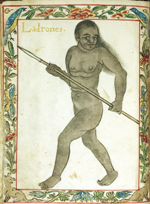
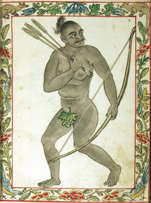 One of the earliest renditions of a Chamorro comes from a manuscript allegedly written sometime in the 1590's. The manuscript is contemporarily referred to as the "Boxer Codex." Just Google it or go to Wikipedia and you will find out more about Boxer Codex. The physical and digital copy of the manuscript is housed at Indiana University.
One of the interesting things of the many mysteries of this manuscript is that although the book cover is labeled "La Del Ladrones," there is only one picture of a Chamorro, which by the way happens to be the first picture in the book. The picture on the right (page 2) following the Chamorro is misleading to the point that one would think that the Chamorro people in the 16th Century had weaponry of bows and arrows, when there has been no archaeological or historical evidence to support it. It is believed that the man with the bow and arrows comes from either a Filipino or other Far Eastern tribe.
A Little Girl Name Mariana
- Details
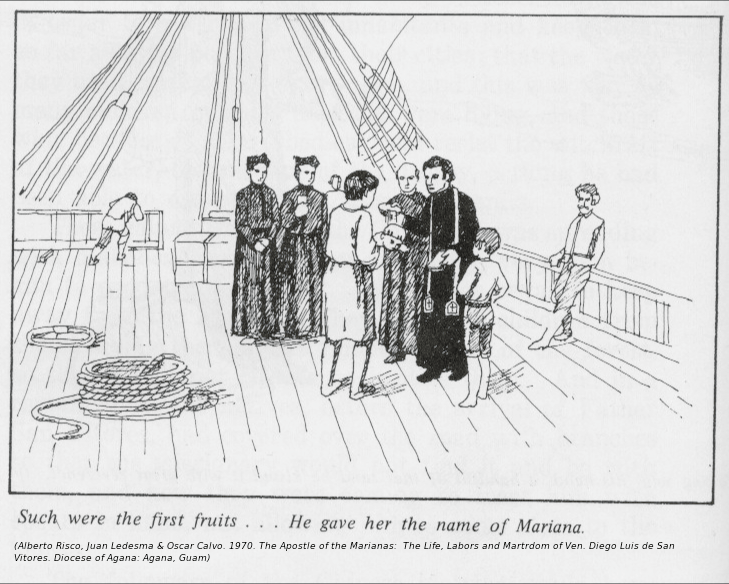
One of the earliest known recorded female children of Chamorro ancestry to be baptized and Christianized was named Mariana. Unfortunately, we do who Mariana’s mother was, but appears to be a Chamorro from Saipan. As for her father, that too remains a controversial mystery; however, most historians seem to agree that the Mariana’s father was a survivor of the 1638 Nuestra Senora de la Concepcion Spanish Galleon shipwreck. He brought Mariana aboard the San Diego ship to meet Father San Vitores.
Mariana was described as being about two years old and dressed in white. Mariana was baptized on 16 June 1668 by Father Luis de Morales. This was the following day after the arrival of the San Diego with Father’s San Vitores and Morales.
Pedro What’s His Name
Most historians seem to agree that Mariana’s father was a Filipino Christian named Pedro. However, Father Risco (1970) and those who cite his works, such as Del Valle (1941) indicate that Mariana’s father was a Spaniard named Pedro, who was a shipwrecked survivor of the galleon Concepcion.
Identifying Pedro’s last name is problematic. Perhaps the most controversial issue to resolve is whether or not Pedro is the same Filipino that was killed along with Father San Vitores by Maga’lahi Mata’pang and Hirao in 1672. You see, because the Pedro that was killed in 1672 along with Father San Vitores, is known as Pedro Calungsod (approximately 17 years old) the second Filipino in history to be declared a Saint, when the Vatican canonized him on October 21, 2012.
Spoehr (1951:48) talks about San Vitores’ group making contact with a “Pedro” who was a survivor of the Concepcion. Spoehr (1951:50) also mentions a “Pedro Calangson,” who was San Vitores’ Filipino assistant and killed, but does not indicate if Pedro and Pedro Calangson was the same person.
Rogers (1995:46) states that Marianas father was Pedro Calonsor (also may be known as Casor or Calangsor in some different accounts), who was a Christian Visayan Filipino. In addition, Rogers (1995:55) also indicates that it was Pedro Calansor that was killed along with Father San Vitores by Maga’lahi Matapang and Hirao. Mata’pang hurled a lance that pierced Pedro Calonsor and then Hirao split Pedro’s head with a cantana.
Lugar (1990) also discusses a Pedro Casor and states, “Sanvitores' band, five priests, a lay brother and thirty lay catechists, encountered two survivors of the Concepcion when they landed on Guam in the middle of June 1668, Pedro Casor, a Christian native of the Bisayan region of the Philippines who became a trusted companion of Sanvitores , and Lorenzo, a native of Malabar.” Lugar’s focus was on the Concepcion and therefore did mention the death of Father San Vitores and his assistant.
Tanya Champaco Mendiola’s (2010) writing is the first one I have come across to actually indicate that there were two different Pedro Calungsor’s: one from the 1638 Concepcion shipwreck and a younger one around seventeen years old (aka Pedro Calungsod) that came with Father San Vitores in 1668.
And finally (for now), I am currently reviewing De Viana’s 2004 book. De Viana (2004:48) contends that the Pedro from the 1638 shipwreck and father of Mariana is Pedro Jimenez. His source: Doc. No. 18 of RAH 9/2656, Official report on the life and death of Fr. Medina, letter of Fr. Sanvitores to the Provincial of the Philippines, Agana, 14 May 1671, cited as Document 1671B in HM 5:131-139. Without having reviewed this source I’m not sure what to believe. However, I have noted that in Quimby (2012) he makes an interesting statement that may further support De Viana. Quimby wrote, “Pedro Jiménez, the Concepción beachcomber who had become a favorite of several chiefs on Guam, came aboard the galleon the day after it arrived and reportedly assured the Jesuits that their request to establish a mission would be favorably received.” I will definitely need to get my hands on De Viana’s source that will help to resolve the conflicting historical information as to who may have been Mariana’s father.
[This writing as with my previous posts on Chamorro people I have written about from the 1600's to the 1800’s remains a work in progress.]
References
Francisco Garcia. 2004. The Life and Martyrdom of the Venerable Father Diego Luis de San Vitores , S.J . Translated by Margaret M. Higgins, Felicia Plaza and Juan M.H. Ledesma. Edited by James A. McDonough. MARC Monograph Series 3. Guam: University of Guam
Catherine Lugar. (1990). The History of the Manila Galleon Trade. Sutton, Vermont: Pacific Sea Resources.
Tanya M. Champaco Mendiola, ' Father Diego Luis de San Vitores', referenced March 7, 2013, © 2009 Guampedia™, URL: http://guampedia.com/father-diego-luis-de-san-vitores/
Mathers W, Parker HS, Copus K. 1990. Archaeological Report: The Recovery of the Manila Galleon Nuestra Senora De La Concepcion. Retrieved August 21, 2012 from: http://pacificsearesources.com/html/contents.html
Frank Quimby, ' The Matao Iron Trade Part 3: Appropriation and Entanglement', referenced March 27, 2013, © 2009 Guampedia™, URL: http://guampedia.com/the-matao-iron-trade-part-3-appropriation-and-entanglement/
Alberto Risco, S.J. 1970. The Apostle of the Marianas: The Life, Labors, and Martyrdom of Ven. Diego Luis de San Vitores, 1627-1672. Translated by Juan M.H. Ledesma, S.J. and edited by Msgr. Oscar L. Calvo. Hagåtña: Diocese of Agana
Robert Rogers. 1995. Destiny’s Landfall: A History of Guam. University of Hawaii: Honolulu, HI
John N. Schumacher, S.J. 2001. Blessed Pedro Calungsod, Martyr: An Historian’s Comments on His Philippine Background. Philippine Studies 49(3): 287-336.
Alexander Spoeher. 1954. Saipan – The Ethnology of a War-Devasted Island. Fieldiana: Anthropology, 41. Chicago Natural History Museum: IL
Augusto V. de Viana. 2004. In the Far Islands: the Role of Natives from the Philippines in the Conquest, Colonization and Repopulation of the Mariana Islands. University of Santo Tomas: Manila, Philippines.
Sister Maria Teresa del Valle. 1941. Tercentenary of the Evangelization of the Mariana Islands – 1668-1968.Guam Recorder, 1(1), p.23. Micronesian Area Research Center, UOG: Guam
Across the Water in Time
- Details
Please visit and support Jillette Leon-Guerrero's current genealogy research project, "Across the Water in Time."
John Paris died in Honolulu in 1928. He is buried next to his wife on the grounds of Oahu’s Kawaiaha`o Church. This Church was the first Christian Church built in Hawaii, and the church where John married his wife Pauelua in 1877. John and his wife had three sons and two daughters.
It would take over 80 years for a descendant to start looking for the origins of her great-grandfather. With no knowledge of his life beyond the Hawaiian Islands, Yolanda Paris Sugimoto reached out to a researcher on Guam to help learn about the roots of her ancestor. The ensuing research would take the two on a journey across the ocean and back in time and yield surprising results that neither could have anticipated.

Page 70 of 84